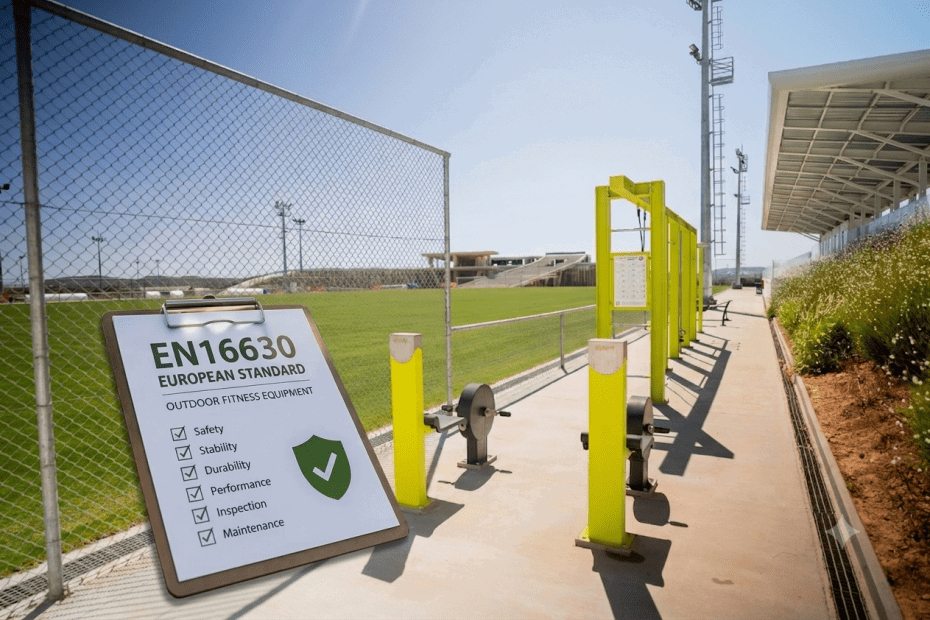
A parks department spends months shortlisting suppliers for a new outdoor fitness trail, then runs into a problem during the final review before installation. Several of the stations under consideration come with no documentation confirming they meet European safety requirements for public outdoor exercise equipment. The order gets delayed and the opening date slips, not because anyone acted carelessly, but because suppliers were compared on price and station count, and the safety standard behind the equipment never came up until it was almost too late.
This is exactly the situation EN16630 is designed to prevent. It is the European standard covering permanently installed outdoor fitness equipment for users aged fourteen and older, shaping decisions long before a contractor breaks ground, from how a pull-up bar is welded together to how a facilities team documents each inspection cycle. Understanding what the standard actually requires, rather than assuming a sturdy appearance is good enough, can save a project from delays and protect an organization’s long-term liability position.
What Is EN16630?
EN16630 is the European safety standard that applies to permanently installed outdoor fitness equipment intended for users aged fourteen and older, or with a standing height above 1,400 mm. It sets out requirements covering the design, construction, installation, inspection, and maintenance of equipment placed in public outdoor spaces such as parks, school grounds, residential developments, and corporate campuses.
Before this standard existed, manufacturers sometimes pointed to playground safety standards or indoor gym equipment standards when describing their products, even though neither one was written with unsupervised outdoor adult exercise equipment in mind. That mismatch created genuine confusion for buyers trying to compare suppliers on a like-for-like basis. EN16630 closed that gap by giving the outdoor fitness sector its own dedicated framework, one that addresses how equipment performs under repeated public use rather than how it looks in a brochure.
Manufacturers that build to this standard typically describe their compliance approach on their product pages, often alongside material specifications and installation guidance, which gives buyers a starting point for comparison before a single quote is requested.
Why EN16630 Matters More Than Most Buyers Realize
When comparing outdoor fitness suppliers, it is easy to focus on what is visible, the variety of stations, the finish colors, the headline price. Those things matter, but they only tell part of the story.
It Supports Safer Public Spaces
Outdoor fitness parks attract people with very different fitness levels and abilities, often using the equipment unsupervised. Equipment engineered to EN16630 reduces foreseeable risks through details easy to overlook from a distance, such as spacing between stations, clearance for a full range of motion, and how moving parts are guarded against pinch points. No standard removes every possible accident, but thoughtful engineering meaningfully reduces hazards tied to poor design.
It Simplifies Procurement
Many municipalities, school boards, and commercial developers specify recognized safety standards as part of their tender requirements. Choosing equipment that already aligns with EN16630 typically makes evaluation more straightforward and gives project sponsors a clearer answer when asked how safety was considered during purchasing.
It Protects Long-Term Investment
Outdoor fitness equipment is usually expected to remain in service for fifteen years or more while exposed to changing weather and frequent use. Durability here is not just about thicker steel. It is about components engineered to perform consistently without introducing new risks as wear accumulates.
It Signals Professional Manufacturing Standards
A manufacturer willing to design around recognized safety requirements is usually organized enough to provide proper documentation and maintenance recommendations too, details that matter just as much once equipment is in the ground as they did during the buying decision.
What the Standard Actually Covers
Many first-time buyers assume EN16630 is simply a certificate that says equipment is safe. In practice it addresses a fairly specific set of technical requirements.
Structural strength and stability sit at the center of it. Pull-up bars, resistance stations, balance equipment, and calisthenics structures all experience repeated dynamic loading day after day, and the standard sets out how that loading should be verified under normal use.
Safety clearance is another major area. Every exercise movement needs room around it, and the standard addresses how much space should separate stations so users can move naturally without colliding with a neighboring structure or another person mid-exercise.
Moving components receive close attention as well. Where equipment includes parts that pivot, slide, or rotate, designers need to account for pinch points, trapping points, and crush risks. Many manufacturers build internal stops and sleeves into these joints specifically to limit how far a moving part can travel, reducing the chance of entrapment while still allowing a natural range of motion. This is the kind of detail that separates equipment genuinely engineered for public use from equipment that simply looks robust.
Fall height and impact-attenuating surfacing are addressed too. Because many stations involve users moving above ground level, the standard sets out how far someone could reasonably fall and what surfacing or ground clearance is needed to limit injury if they do, alongside the wider movement area, or fall zone, that needs to stay clear around each station.
Finally, the standard places real importance on user information. Clear instructional signage, sometimes paired with a QR code linking to usage and safety guidance, helps both first-time exercisers and experienced athletes use a station correctly.
Where Buyers Commonly Go Wrong
The most frequent mistake is judging equipment almost entirely on appearance, price per station, or the number of exercise options included. These factors are easy to compare at a glance, which is exactly why they get more attention than they deserve.
A closely related mistake is assuming a heavy, solid-looking frame automatically means the equipment is compliant. Steel thickness on its own says nothing about clearances, entrapment risk, or how the manufacturer actually tested the product. Two stations can look almost identical and differ significantly underneath the surface.
It is also common for procurement teams to request a quote without asking for supporting documentation until much later, sometimes not until after an order has already been placed. Asking for test reports, a declaration of conformity, and installation drawings during the comparison stage avoids the kind of last-minute scramble that delays projects.
Finally, some buyers treat compliance as a one-time checkbox rather than an ongoing responsibility. EN16630 covers inspection and maintenance as well as manufacturing, which means staying compliant depends on how a facility manages the equipment for years after installation, not just what was true on delivery day.
What Causes Premature Equipment Failure
Even compliant equipment can fail early if the conditions around it are not accounted for. Climate exposure is one of the biggest variables. Coastal installations dealing with salt air and strong UV exposure age differently than equipment exposed to frequent freeze-thaw cycling, and a finish that performs well in one environment may need closer attention in another.
Missed inspection cycles are another common cause. A loose fixing or worn bearing rarely fails the equipment outright on its own, but left unaddressed across multiple seasons it can accelerate wear on surrounding components.
Installation quality plays a large role too. Footing depth, ground anchoring, and surface preparation all affect how equipment handles repeated dynamic loading, and even well-engineered equipment can develop problems if it was not installed to specification.
Finally, equipment never designed for continuous public outdoor use, repurposed indoor gym frames being a common example, tends to wear unevenly because it was engineered around a different use case altogether.
Materials and Engineering Choices Behind Compliant Equipment
Outdoor fitness equipment sits outside in all weather, which makes material choice central to compliance and longevity alike. Galvanized steel, finished with weather-resistant powder coating, is widely used because it resists corrosion while standing up to repeated impact and grip pressure from daily public use.
Some manufacturers also incorporate recycled steel into their frames as part of a broader sustainability approach, which can be worth asking about during procurement if environmental criteria factor into a tender.
Equipment with adjustable resistance, often found in professional-grade station lines, adds another layer of engineering complexity, since the locking mechanism itself has to meet the same entrapment and clearance expectations described above.
Buyers comparing manufacturers can usually get a sense of how seriously a company treats this side of engineering by looking at how openly its quality processes are documented.
The Certification and Procurement Process Explained
In practice, EN16630 compliance is typically demonstrated through manufacturer-issued documentation rather than a single universal certificate. This can include test reports, a declaration of conformity, technical drawings, and installation guidance specific to the products being purchased.
Exactly how this documentation needs to be presented, and whether independent third-party testing is required for a given project, can vary by country and by the nature of the buyer, whether that is a public authority, a school, or a private developer. Procurement teams should confirm the specific requirements that apply to their tender with their own national or local authority before finalizing a contract, since requirements that hold true in one country are not automatically guaranteed to apply identically elsewhere.
What buyers can reasonably expect from any established manufacturer is a willingness to share this kind of documentation openly, along with maintenance recommendations and installation drawings, well before a purchase order is signed.
Cost and Lifecycle Factors
Upfront price is only one part of the financial picture. Outdoor fitness equipment is typically expected to stay in service for fifteen years or more, and total cost of ownership depends heavily on how the equipment is maintained, how harsh the climate is, and how intensively it gets used.
Climate exposure plays directly into this figure, for the same reasons covered above, and it is a sensible line item to plan for rather than a surprise to discover years into ownership.
Buyers who factor lifecycle costs into their decision from the start, rather than focusing purely on the initial quotation, tend to end up with a more accurate picture of what the equipment will actually cost across its working life.
Who Should Prioritize EN16630-Compliant Equipment
Local authorities and parks departments are responsible for amenities that need to serve their communities safely for years, which makes documented compliance a meaningful part of planning long-term outdoor fitness installations rather than a one-off purchase.
Schools and universities face similar considerations, since outdoor fitness installations on campus are typically used by students, staff, and often the wider community outside school hours.
Residential and commercial developments are increasingly adding outdoor wellness spaces as a lifestyle feature, and developments that serve a wide range of residents, including senior living communities, benefit from equipment specifically engineered for varied mobility levels.
Landscape architects and contractors specifying equipment on behalf of a client carry a related responsibility, since the products they recommend need to hold up to the same scrutiny as if they had purchased the equipment directly.
Maintenance Expectations Under EN16630
Compliance does not end at installation. The standard includes guidance on inspection and ongoing maintenance because outdoor fitness equipment is expected to remain safe throughout years of public use, not just on the day it is delivered.
Denfit’s guidance to customers sets out three layers of inspection, each on its own schedule. Visual inspection happens most often: once or twice a month depending on how heavily a site is used, stepping up to weekly or even daily checks at locations facing intensive use or vandalism. Operational inspection and maintenance of moving parts follows a slower rhythm, starting three months after installation and then repeating every six months. A full annual inspection and maintenance round, covering everything else on the installation, also starts three months after installation and then repeats once a year from that point on. Inspection records and maintenance logs matter here too, since they give a facility a documented history to refer back to if a question about a station’s condition ever comes up.
Wear components, such as bearings, bushings, and certain fixings, are designed to be replaceable, and having a clear plan for sourcing those parts before they are needed avoids longer downtime later.
Common Misconceptions About EN16630
One persistent misconception is that EN16630 is essentially a playground standard. It is not. Playgrounds and outdoor fitness parks are governed by separate standards because they serve different age groups and different equipment types altogether.
Another is the belief that compliance only matters for government-funded projects. Private developers, schools, and commercial operators benefit just as much from choosing compliant equipment, since it reflects the same engineering rigor regardless of who is paying for it.
A third misconception is that once equipment passes inspection at installation, the compliance conversation is closed. As covered above, the standard treats ongoing maintenance as part of the picture, not an afterthought.
How Manufacturers Approach Safety and Compliance
Meeting these expectations starts well before equipment reaches a public park, during the product development stage where engineering decisions shape everything from user experience to how the equipment ages over time. Companies with a long manufacturing history in this space, such as Denfit International, which has built outdoor fitness equipment in the Netherlands since 2001 as one of Europe’s first companies to focus entirely on the category, tend to bring that institutional experience into how they approach durability, signage, and inclusive design across very different climates and use cases.
Frequently Asked Questions
What is EN16630?
EN16630 is the European safety standard for permanently installed outdoor fitness equipment used by people aged fourteen and older. It sets requirements across design, construction, installation, inspection, and maintenance, replacing the earlier practice of referencing playground or indoor gym standards that were not built for this kind of equipment.
Is EN16630 legally required everywhere?
That depends on the country and the project. Many public tenders specify it directly, while private developments may reference it voluntarily as a quality benchmark. Procurement teams should confirm the exact legal requirements in their own jurisdiction rather than assuming the same rule applies everywhere.
What equipment does EN16630 actually apply to?
It applies to permanently installed outdoor exercise equipment such as pull-up stations, resistance machines, balance equipment, and calisthenics structures placed in parks, schools, and residential or commercial developments. It does not cover playground equipment for younger children or indoor gym machines, which fall under separate standards. It also excludes powered equipment, functional training equipment with movable free weights, and military-style obstacle courses, which fall under separate frameworks.
How is EN16630 different from playground standards like EN1176?
EN1176 was written for children’s play equipment and the risks specific to that age group, while EN16630 addresses adult and teenage exercise equipment used for strength, mobility, and cardiovascular training. Treating the two as interchangeable during procurement is one of the more common sourcing mistakes buyers make.
How often should compliant equipment be inspected?
Denfit recommends visual inspection once or twice a month, increasing to weekly or daily checks at high-use or vandalism-prone sites. Operational inspection and maintenance of moving parts should happen three months after installation and then every six months. A full annual inspection covering all other components should also start three months after installation, then repeat once a year. Local climate and usage intensity can push facilities toward tighter intervals than this baseline.
What documentation should buyers request before purchasing?
Reasonable requests include test reports, a declaration of conformity, installation drawings, and a recommended maintenance schedule specific to the products being purchased. Manufacturers confident in their engineering should be able to share this during the comparison stage, not only after a purchase order has already been signed.
Does EN16630 compliance guarantee equipment will never fail?
No standard can guarantee that. Compliance significantly reduces foreseeable risks tied to poor design and construction, but real-world outcomes still depend on installation quality, climate exposure, usage intensity, and how consistently a facility carries out inspection and maintenance over the equipment’s working life.
Final Thoughts
Choosing outdoor fitness equipment involves more than comparing exercise stations or quotations side by side. Safety, durability, and long-term reliability all shape whether a project succeeds, particularly when the equipment will sit in a public space and see use from hundreds of people every year.
Understanding EN16630 gives buyers a practical framework for evaluating suppliers and asking better questions before money changes hands, covering how equipment is engineered, documented, installed, and maintained over its working life. Whether the project is a community fitness trail, a school upgrade, or a wellness space for a residential development, that understanding tends to pay for itself well before the first user ever sets foot on the equipment.