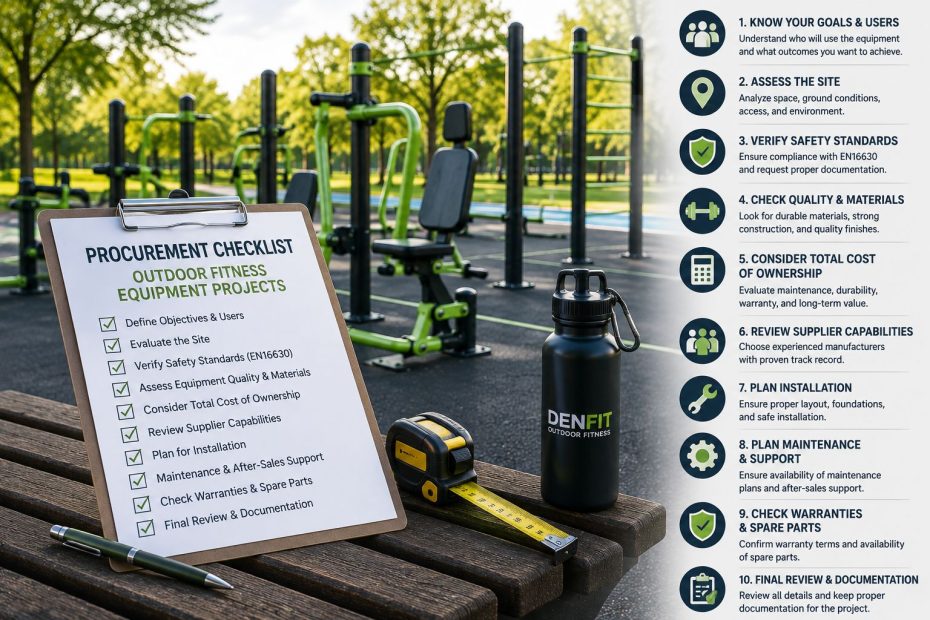
Choosing outdoor fitness equipment is rarely as simple as picking products from a catalog. Behind every successful installation sits a procurement process that accounts for site conditions, user demographics, safety standards, maintenance needs, supplier capabilities, and long-term value. Skip any of these and even a well-intentioned project can end up with low usage, unexpected repair bills, or equipment that no longer fits the community within a few years.
Procurement decisions carry the same weight for a neighborhood park, a school campus upgrade, or a wellness amenity inside a residential development. Getting the process right keeps the investment delivering value for years while making efficient use of the available budget.
This checklist works through the considerations every buyer should address before committing to an outdoor fitness equipment project.
Start With Clear Objectives and a Clear Picture of the Users
One of the most common procurement mistakes is comparing equipment before deciding what the project is actually meant to achieve. A park built to encourage daily activity among residents needs a different equipment mix than a senior living community focused on mobility and balance, and a school or workplace wellness program needs a mix reflecting its own users altogether.
Settling on objectives first, encouraging community health, supporting inclusive recreation, increasing visitor engagement in an existing park, or adding a wellness feature to a development, makes every later decision easier, since it shapes equipment selection, layout, accessibility, and maintenance priorities.
The intended users matter just as much as the goal itself. Whether the space mostly serves adults, seniors, teenagers, or families changes equipment placement, safety clearances, and signage. Combining cardiovascular, strength, balance, flexibility, and functional stations, instead of designing for a single group, broadens participation and supports inclusive recreation across a wider range of abilities.
Evaluate the Site Before Comparing Equipment
Every location comes with its own constraints, so procurement should start with a real site assessment instead of assuming a product will perform the same way everywhere.
Accurate measurements determine how many stations actually fit while keeping safe circulation space, since an overcrowded layout creates both usability and maintenance problems. Soil composition, drainage, slope, and existing surfaces affect foundation requirements and installation cost, and catching these issues early avoids surprises once construction begins.
Climate matters just as much. Coastal salt air, high humidity, heavy snowfall, and intense UV exposure each place different demands on materials and protective finishes. Finally, the space should be reachable from nearby paths, parking, and transit, with planning that accounts for users with mobility aids from the start rather than as an afterthought.
Verify Safety Standards and Documentation
Compliance should never be an afterthought. Public outdoor fitness installations need to meet recognized safety standards that protect both users and the organization purchasing the equipment. Across Europe and many international markets, EN16630 is the primary safety standard for permanently installed outdoor fitness equipment, covering structural integrity, safety clearances, user information, durability, inspection, and ongoing maintenance.
Meeting the standard is the starting point, not the finish line. Buyers should also ask for independent test reports, material certifications, installation guidelines, maintenance documentation, and warranty terms, since experienced manufacturers treat compliance as something that runs through the equipment’s entire service life rather than ending once it leaves the factory.
Look Beyond Appearance to Materials and Range
Modern outdoor fitness equipment often looks impressive in a brochure, but appearance alone should never drive a procurement decision. What matters more is what sits underneath: the steel used in structural components, how welded joints are protected against corrosion, what surface treatment improves long-term durability, and how readily replacement parts can be sourced years after installation. Manufacturers such as Denfit International, which has built outdoor fitness equipment in the Netherlands since 2001, document this kind of detail directly, including material certifications and finish specifications, on their product pages.
Most projects also need more than one type of station to create a genuinely balanced experience. A supplier capable of covering strength, cardio, balance, flexibility, functional fitness, and senior-friendly or inclusive equipment under one product range usually simplifies planning and keeps design, finish, and maintenance consistent across a site, compared with combining unrelated products from several manufacturers.
Weigh Total Cost of Ownership, Not Just the Quote
Budget always matters, but the lowest quotation often becomes the most expensive choice over time. Outdoor fitness equipment needs to perform for many years under constant public use and changing weather, and a lower purchase price can be wiped out by higher maintenance bills, more frequent repairs, or an early replacement.
Total cost of ownership is the better lens: expected service life, material quality, how often maintenance is needed and what it costs, spare parts availability, warranty coverage, and how easy inspections and repairs actually are. None of this shows up on the original invoice, but it usually decides what the equipment really costs over its working life.
Every installation needs ongoing maintenance regardless of how durable it is. What separates an easy program from a difficult one is whether the supplier provides clear inspection schedules, cleaning guidance, maintenance manuals, and ready access to spare parts before the purchase is even finalized.
Assess the Supplier, Not Just the Product
Procurement is really a long-term partnership, since the supplier chosen today may keep supporting the project for years through technical advice, spare parts, warranty service, and future expansion. Worth asking: how long the company has manufactured outdoor fitness equipment, whether it has delivered comparable international projects, whether manufacturing is handled in-house, and what after-sales support is realistically available once installation is complete. A supplier’s manufacturing history is often a useful starting point for this comparison.
Plan for Growth and the Space Around the Equipment
Communities change, and a park that fits today’s needs may need more stations once participation grows or a nearby development brings in new users. Modular layouts and a consistent product family make it easier to add equipment later without the site looking patched together, and they let an organization spread investment across multiple budget cycles instead of funding everything at once.
The equipment itself is only part of what makes a space work. Seating, shade, drinking water, lighting, clear signage, and comfortable paths between stations all affect whether people actually return, often more than the exercise stations themselves.
Common Procurement Mistakes Worth Avoiding
A handful of mistakes show up across most troubled projects. Choosing based on price alone overlooks how durability and maintenance shape the real cost over time. Designing around available land instead of how the community will actually use the space leads to equipment that goes unused. Skipping a realistic maintenance plan lets performance and safety quietly decline, while picking a supplier with weak long-term support creates problems the moment a part needs replacing. Planning only for today’s numbers, instead of for growth, often forces a redevelopment that a more flexible layout would have avoided.
A Practical Procurement Checklist
Before approving a project, confirm the following:
✓ Project objectives are clearly defined
✓ Equipment matches the needs of the intended users
✓ The installation site has been fully assessed
✓ Equipment complies with applicable safety standards
✓ Material quality and durability have been verified
✓ Accessibility is built into the design
✓ Maintenance requirements have been reviewed
✓ Lifecycle costs have been weighed against purchase price
✓ The supplier has proven manufacturing and project experience
✓ Warranties, documentation, and after-sales support are clearly defined
✓ The installation can be expanded later if needed
✓ The project supports broader community health goals
Working through these points before signing off reduces risk and helps create a facility that keeps delivering value well beyond installation.
Final Thoughts
An outdoor fitness park is a long-term public investment, and the equipment chosen today shapes how people exercise and connect with their community for years afterward. Strong procurement looks past specifications and quotations to user needs, site conditions, safety standards, maintenance planning, and supplier experience.
Working through these considerations in order, instead of reacting to whichever quote arrives first, tends to produce installations that stay safe, well used, and adaptable as the community around them changes. That structured approach, more than any single product choice, decides whether a fitness park still serves its community fifteen years from now.
Frequently Asked Questions
What should be the first step in an outdoor fitness equipment procurement process?
Define clear objectives before comparing products. A project meant to encourage daily activity needs a different equipment mix than one focused on senior mobility or a school’s curriculum, and that objective should drive every later decision, including equipment selection, site layout, accessibility, and which suppliers get shortlisted.
What is EN16630 and why does it matter in procurement?
EN16630 is the European safety standard for permanently installed outdoor fitness equipment, covering structural integrity, safety clearances, durability, inspection, and maintenance. Procurement teams should request documentation proving compliance, along with independent test reports and material certifications, rather than accepting a verbal assurance from a supplier.
How should buyers compare total cost of ownership instead of just the purchase price?
Compare expected service life, maintenance frequency and cost, spare parts availability, warranty coverage, and how easy inspections and repairs are in practice. A lower upfront quote that requires frequent repairs or an early replacement usually costs more across the equipment’s working life than a higher-priced option built for durability.
What questions reveal whether a supplier can support a project long term?
Ask how long the company has manufactured outdoor fitness equipment, whether manufacturing happens in-house, whether it can provide references from comparable projects, and what after-sales support, spare parts access, and warranty service actually look like years after installation, not just at the point of sale.
How does planning for future expansion affect equipment selection now?
Choosing a modular layout and a consistent product family from the outset makes it possible to add stations later without the site looking patched together, and it lets an organization spread the investment across multiple budget cycles instead of funding everything at once.